TÜRKÇE
Karabel Reliefs
The large relief is in the Karabel Pass on the Kemalpaşa-Torbalı road, on the southern slope of a mountain, on the left side of the road. It is about 1.5 meters wide and 2.5 meters high. A male figure is depicted standing with a bow in his right hand and a spear in his left, wearing a tunic and a cone-shaped hat. This relief is referred to as Karabel A among the scholars. Between the head of the warrior and the spear, there are three lines of a badly worn-out Hieroglyphic Luwian inscription, barely visible to the human eye. In 2017 and 2019, the bottom half of the relief suffered heavy damage at the hands of the treasure seekers.
The monument may have been mentioned by Herodotus in his history, where he identified the carved figure as the Egyptian pharaoh Sesostris: "... in Ionia there are two figures of this man carved upon rocks, one on the road by which one goes from the land of Ephesus to Phocaia, and the other on the road from Sardis to Smyrna. In each place there is a figure of a man cut in the rock, of four cubits and a span in height, holding in his right hand a spear and in his left a bow and arrows, ... and from the one shoulder to the other across the breast runs an inscription carved in Egyptian hieroglyphics, saying, 'This land with my shoulders I won for myself.' " (Herodotus II.106). Karabel Pass is not exactly on the ancient Sardis-Smyrna road, but rather on the Sardis-Ephesus road, and the Ephesus-Phocai road lies far to the south to take into consideration. Herodotus was either mistaken in his description, or it is possible that he was referring to a different but similar relief. The recent discovery of the Torbalı relief indicates that there may have been multiple similar monuments in the region. Needless to say, the person depicted in the relief is not an Egyptian king. The reading of the Karabel A inscription was published by David Hawkins in 1998. Hawkins reads the three-line inscription as:
Tarkasnawa, King of Mira (land).
[Son of] Alantalli, King of Mira land.
Grandson of ..., King of Mira land.
Alantalli reading is not certain. Also, although the name of the grandfather is not readable, it was suggested to be Kupanta-Kuruntiya. The reading of Hawkins also reveals Tarkasnawa to be the same person as Tarkondemos, who appears in some Boğazköy seals. The Tarkasnawa reading has been widely approved by scholars. Mira was a vassal kingship of the Hittite domain, and its king, Alantalli, was a known contemporary of Tudhaliya IV. His son(?), Tarkasnawa, therefore, should be a contemporary of Tudhaliya IV and/or Suppiluliuma II, which would date the monument to the end of the 13th century BCE.
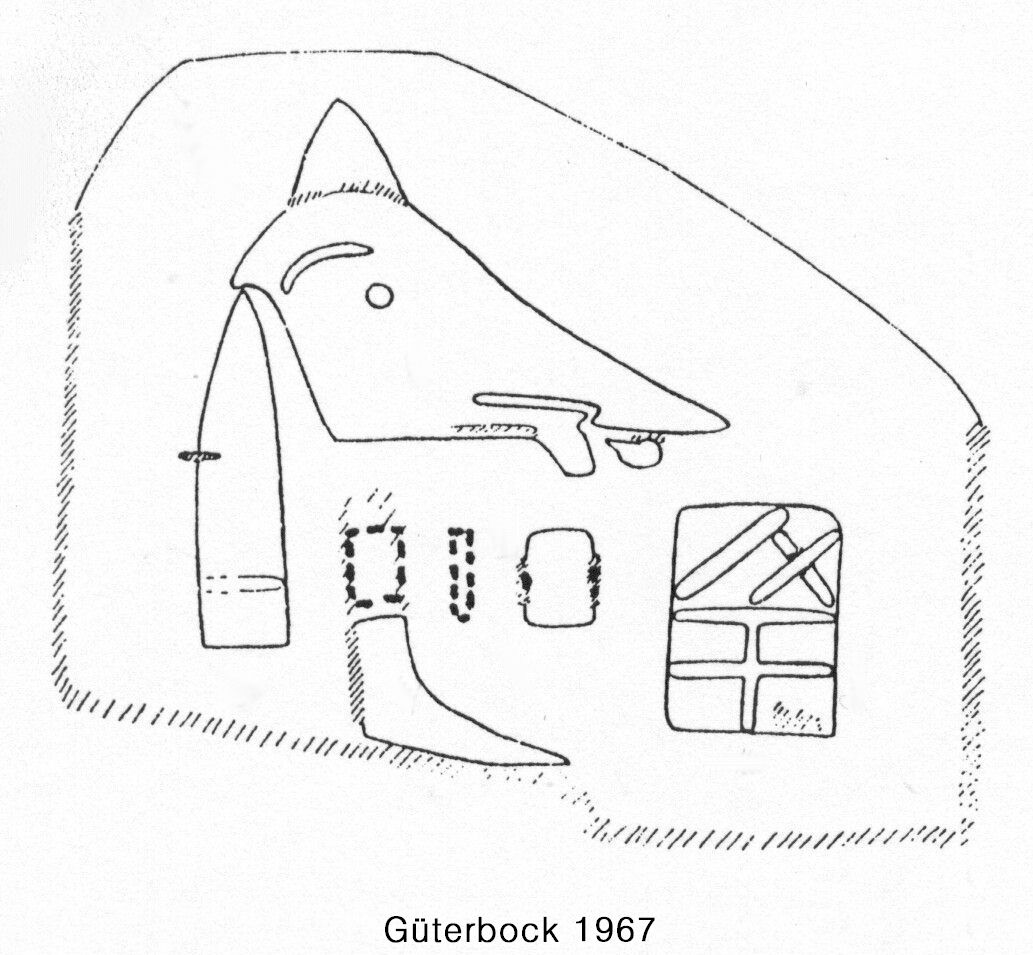
About a hundred meters north of the Karabel A relief was another relief similar to it and two separate hieroglyphic inscriptions. The three of them were named Karabel B, Karabel C1, and Karabel C2, respectively. Unfortunately, during the widening of the nearby road, these three carvings were completely destroyed sometime between 1977 and 1982. Karabel B also displayed a standing male figure with a spear on his extended left hand and probably a bow on the right shoulder. The worn-out inscription on the relief was unreadable other than the first character, which was probably 'King.'
The inscriptions C1 and C2 were located on the perpendicular surfaces of the same rock just a few meters to the north of Karabel B. The C1 inscription was the better preserved of them with five hieroglyphic characters. This inscription might be a scribal signature. Although "King of Mira" and "Alantalli" readings had been proposed for parts of C2, nothing certain could be read.
Click on the pictures for larger images.
Karabel A


Karabel B, C1 and C2