TÜRKÇE
Hama
Hama is the modern-day name of the old Hamath. The region came under Hittite rule during the Empire period, but its name is not attested in any sources during that time. After the fall of the Hittite Empire, the city was an independent kingdom in the 10th to 9th centuries BCE and was known as Imatu in the Luwian inscriptions. Later it came under Aramaean rulers, although the Neo-Hittite/Luwian culture of the city must have continued for a while. By the time it was invaded in 720 BCE, Assyrian king Sargon II was referring to the city's Aramaean-named ruler as the "wicked Hittite."
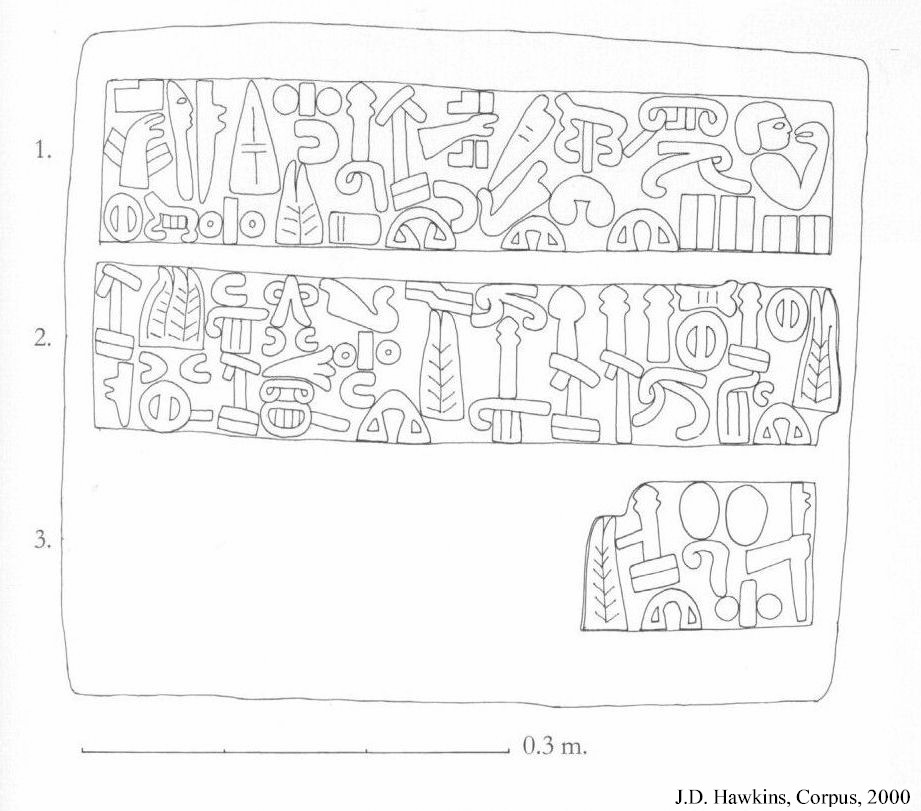
Several monumental blocks with Hieroglyphic Luwian inscriptions that date from the 9th century BCE have been found in and around Hama. Four of the inscribed stones were found in the walls of some buildings (HAMA 1-4). They are among the very first artifacts that attracted the modern-day researchers to the existence of a Hittite civilization and language. The stones were first noted in 1812 by J. L. Burckhardt. In 1872 they were moved to the museum in Istanbul. The texts on the blocks are building inscriptions of the kings of Hamath, Urahilina, and his son Uratami. Urahilina must be the same person as Irhuleni known from Assyrian sources as the king of Hamath and one of the leaders of the Syrian coalition who faced Shalmaneser III at the battle of Qarqar in 853 BCE.
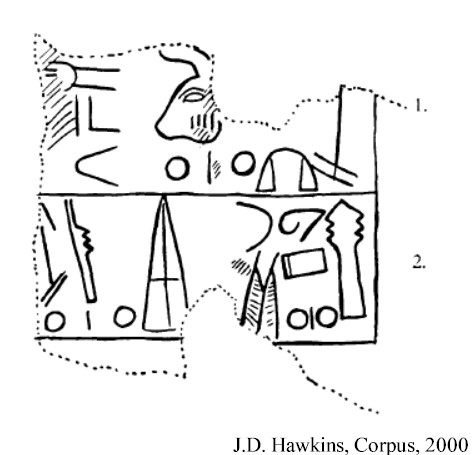
Other similar blocks found in 1958 and 1970 are currently in Hama Museum (HAMA 6-7). HAMA 8 is known only by a photograph obtained from an antiquities dealer. HINES, another building inscription of the type of Urahilina, was found in 1924 in northern Iraq, but given its peculiarities, J. D. Hawkins suspects it to be an antique copy from another Hama stele. Restan, Qalat el Mudiq, and Tall Šṭīb are other locations where inscriptions of Urahilina have been found.
Several gate lions and orthostats dating to the Neo-Hittite era were excavated during Danish excavations under Harald Ingholt in 1931-1938 at Hama citadel. Some of these finds are in the museums of Hama, Aleppo, and Copenhagen, and the whereabouts of a few others are not clear.
Click on the pictures for larger images.
HAMA 1 and 2


HAMA 3 and 4


HAMA 5, 6 and 7


HAMA 8 and HINES


Gate lions and others


